|
Some microorganisms from Finistere, Bretagne, France, 2026 |
|
|
| |
Again the microscopy workshop was held again at the "Wildnisschule Teerofenbrücke"at the end of May. As in the years before, a focus was on the study of on the "aufwuchs" on slides that had been exposed a few days earlier in various places on the side arms of the Oder. A heartily "Thank you" to R. and U. Szewzyk for preparing and organizing this workshop!.
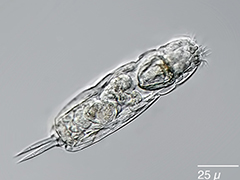
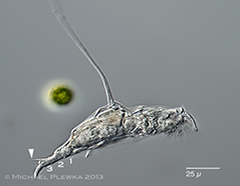
The focus of my own observations was the study of (dry) mosses and ephemeral waters for rotifers. Some previously never seen morphotypes were discovered, such as Cephalodella intuta, Monommata aequalis, Monommata maculata. Also the backward movement / swimming of Collotheca mutabilis (and thus the reverse beating of the cilia of the infundibulum) could be documented in a video. |
|
|
|
|
|
 |
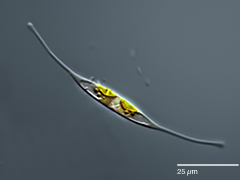
Cylindrotheca sp. |
|
|
|
|
|
|
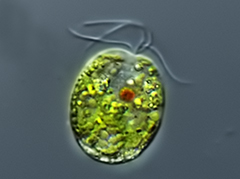
Tetraselmis sp. is a single-celled green alga with a conspicuous "eyespot" (photoreceptor???) and 4 flagella. The alternating rotation of the cell in clockwise and counter-clockwise direction raises the question, if and/ or how the beat of the 4 flagella is coordinated.
One species of this genus: Tetraselmis convolutae is also living as symbiont in the worm Symsagittifera roscoffensis (Xenacoelomorpha).The remnants of the digested diet are spit out through the mouth, again with the help of the trophi.
See the YT-video here >>> |
|
|
|
|
|
 |
|
|
|
|
|
|
|
|
|
|
|
|
Epiphnes senta |
|
|
|
|
|
Kostea wockei |
|
|
|
|
|
Lecane clara |
|
|
|
|
|
Proales similis |
|
|
|
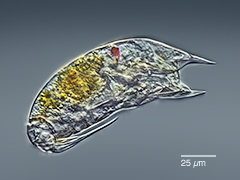
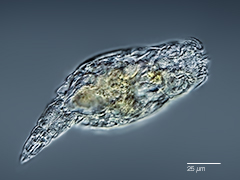
Proales similis is recorded as species with red eyespot. The species found in Bretagne is a morphotype without eyespot: Proales similis exoculis. |
|
|
|
|
|
 |
|
|
|
|
|
|
|
|
|
|
|
|
|
|
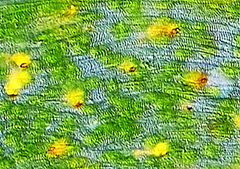
The marine Roscoff-worm (Symsagittifera roscoffensis) is a green acoel worm, the color of which is due to the symbiosis with the green alga Tetraselmis convolutae. Like in polyclad flatworms the movement of this animal is accomplished by cilia which cover the whole body. The beating of the cilia results in metachronal waves that are dexioplectic in this species. This can be observed by slow-motion video (12x time-expansion)
See the YT-video here >>> |
|
|
|
|
|
 |
|
|
|
|
|
|
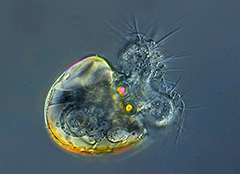
Gastropod veliger larva with strange optical properties of the eyes. The cilia of the velum move in laeoplectic metachronasl waves. More on this here >>> |
|
|
|
|
|
 |
|
|
|
|
|
|
|
|
|
|